Vertical Timing and Hue Coordination in Color Jump
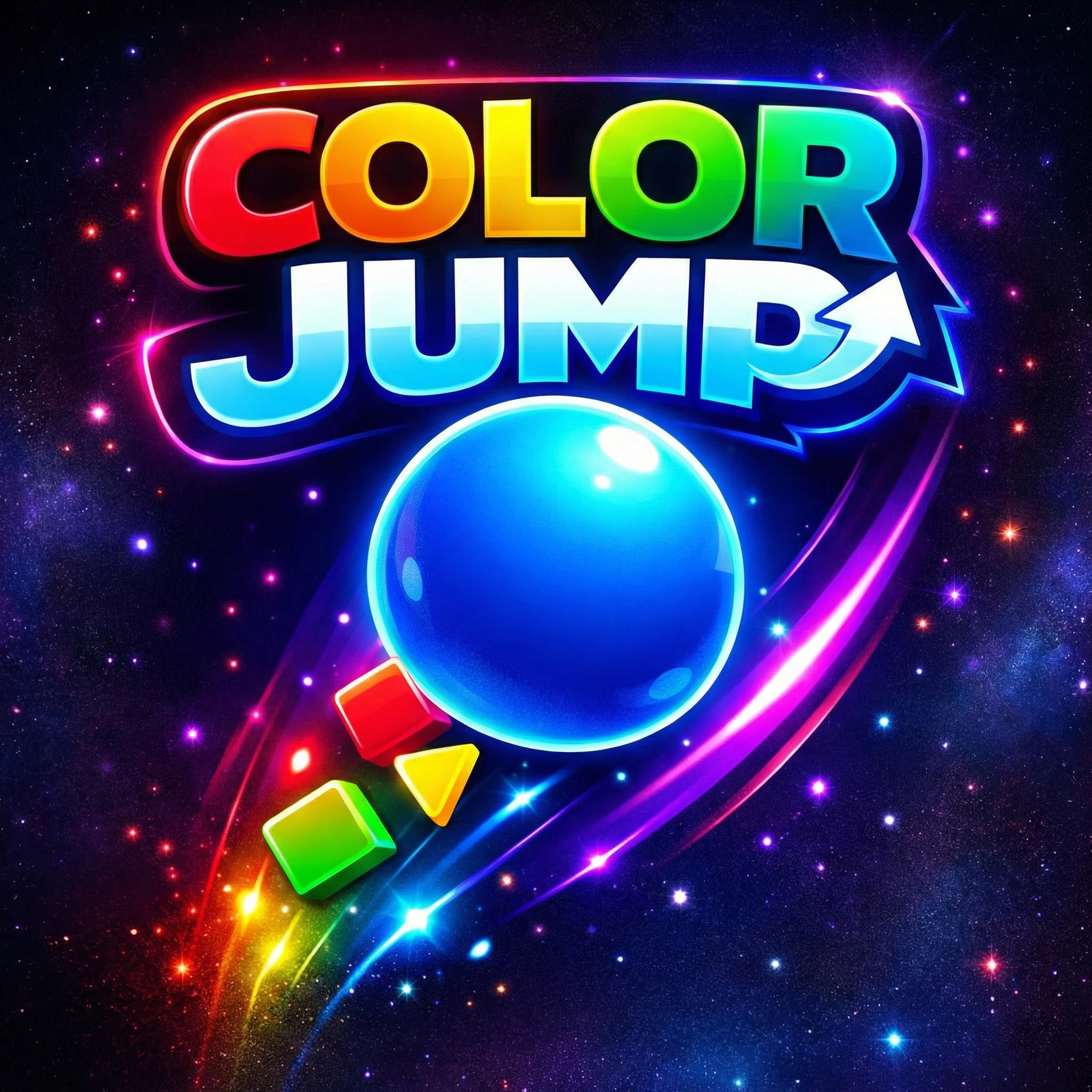
Color Jump takes a single-button hopping mechanic and turns it into an exacting exercise in visual timing and color coordination. You control a glowing sphere that continuously falls under gravity. Each click, tap, or press of the Spacebar gives the ball an upward impulse. Your objective is to bounce upward through an endless sequence of rotating geometric barriers, including concentric rings, spinning crosses, triangles, and multi-segmented wheels.
The core rule is uncompromising: your ball can only pass through barrier segments that match its current color. If your ball is yellow, you can glide effortlessly through yellow bars, but brushing against purple, cyan, or magenta segments ends your climb instantly. To complicate matters, passing through glowing rainbow orbs periodically shuffles your ball to a completely different color, demanding instant visual recalibration.
Mastering the Mid-Air Hover Rhythm
Beginners in Color Jump usually fail because they try to ascend too quickly. They see an obstacle, mash the jump button three times, and collide with an incoming bar before it has finished turning. The secret to high scores is mastering the mid-air hover. By delivering gentle, evenly-spaced taps, you can keep the ball hovering in place within safe pockets beneath an obstacle for as long as you need.
Use this hovering window to study the rotational speed and direction of the barrier above you. Count the rhythm: tap, fall, tap, fall. Once your matching color segment swings into the bottom entry quadrant, deliver two firm taps to shoot cleanly through the gate and enter the hollow center of the shape. Once inside, resume your hovering cadence until the upper exit segment rotates into alignment.
Handling Color Orbs and Concentric Rings
Between major obstacle clusters sit floating multi-colored spheres. Passing through one of these orbs changes your ball to a random new hue. The biggest mistake players make is assuming their ball color stayed the same. Always look directly at your ball the instant you pass an orb. If you were yellow and turn cyan, your immediate target changes from the yellow segment to the cyan one.
Advanced stages introduce concentric rings that rotate in opposing directions. The outer circle might spin clockwise while the inner circle spins counter-clockwise. Squeezing through these double gates requires timing the exact moment when both matching segments overlap. If they do not align cleanly on this pass, do not force the jump. Stay calm, hover safely in the lower pocket, and wait for the two rings to cycle back into synchronization.
Color Jump Timing Strategy and Player Q&A
How do you keep the ball from falling while waiting for an opening?
Use light, rhythmic taps to maintain a stable hover. Space your inputs roughly half a second apart so the ball bobs gently up and down without gaining excessive vertical momentum.
What should you do immediately after collecting a rainbow orb?
Glance at your ball to identify your new color before attempting any further upward jumps. Committing to a gate with outdated color memory is the most common cause of sudden resets.
Can you pause or rest inside geometric shapes?
Yes. The hollow interior of spinning rings and squares provides a temporary safe zone. You can hover inside the shape while waiting for the top exit segment to rotate into place.
Are keyboard controls or mouse clicks better for climbing?
The Spacebar is widely favored by desktop players because a broad thumb press produces less finger fatigue than repetitive mouse clicking, providing more consistent hover rhythms over long sessions.