Arc Calibration and Trajectory Physics in Basket Ball
Basket Ball distills the pure satisfaction of shooting hoops into an engaging 3D trajectory challenge. Set against an open-air stadium flanked by colorful spectator seating and rolling clouds, you stand on a vivid green hardwood court with a regulation basketball at your fingertips. Your objective is simple: read the distance to the blue backboard and orange rim, calibrate your release angle, and sink baskets to build an unbroken scoring streak.
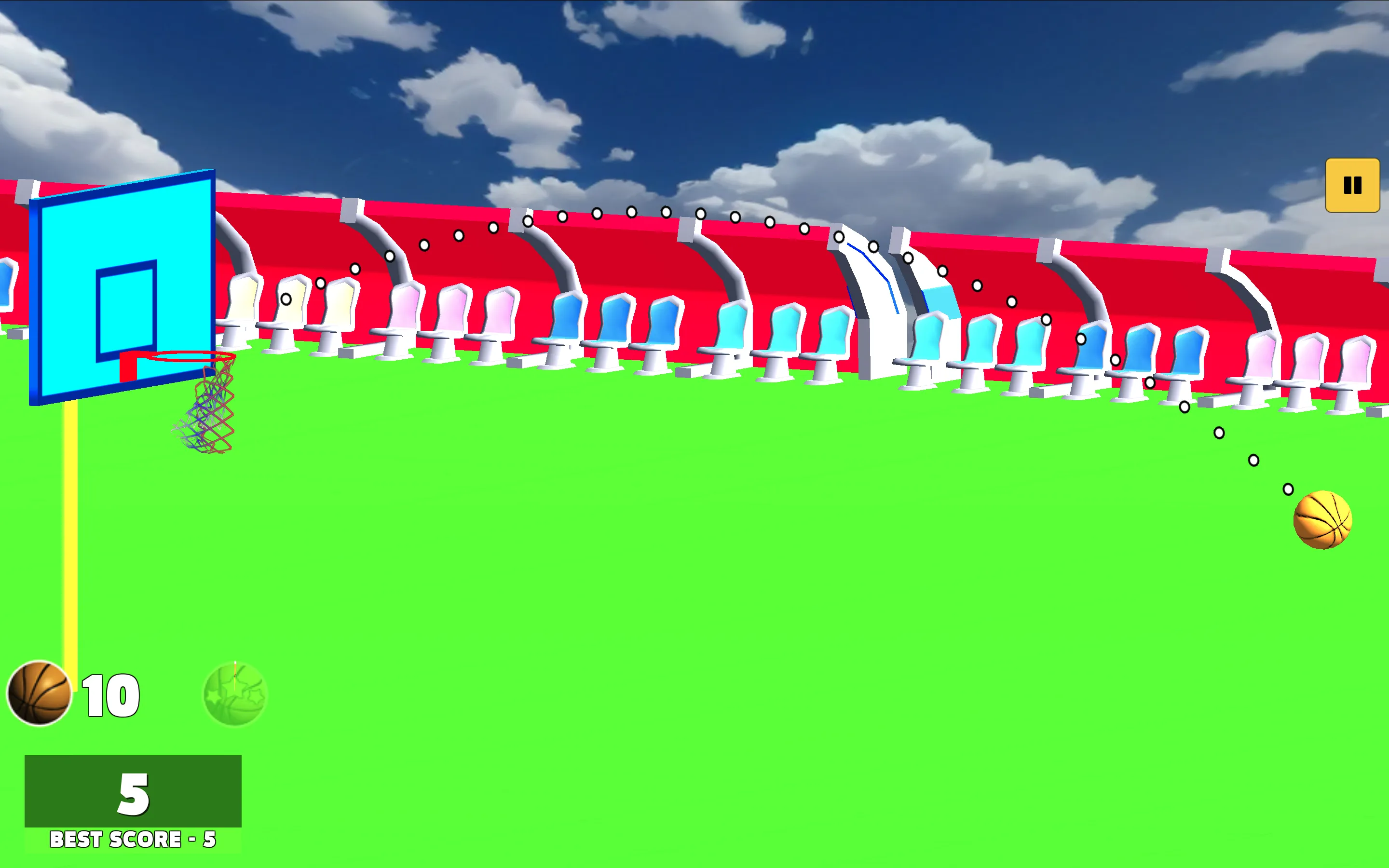
Unlike rapid tap-to-shoot basketball games, this title places heavy emphasis on parabolic physics. When you click or touch the ball and drag backward, a dynamic white dotted trajectory guideline projects outward across the court. This aiming guide calculates gravitational pull and forward velocity in real time, giving you visual feedback before you let go of the ball.
Mastering Entry Angles and Backboard Bank Shots
Achieving a high score in Basket Ball requires understanding how the basketball interacts with the rim at different angles of descent:
- The Power of High Arcs: A flat, low-trajectory shot views the rim as an elliptical slit, giving the ball very little margin for error and causing harsh bounces off the front iron. A steep parabolic arc causes the ball to plunge almost vertically downward, exposing the entire 18-inch diameter of the rim for clean swishes.
- Banking Off the Backboard: When shooting from peripheral court positions or longer distances, aim the apex of your dotted line slightly behind the orange rim so the ball strikes the blue backboard. The backboard cushions the impact and directs the ball downward into the mesh.
- Managing the 10-Ball Reserve: You begin each run with a bank of 10 basketballs, tracked in the lower-left corner beside your active score. Every made basket preserves your ammo pool, while missed shots tick your reserve downward. Running completely out of balls ends the session.
Developing Consistent Drag Muscle Memory
Because the court perspective remains fixed while your shooting distance shifts, learning subtle variations in drag distance is essential. On desktop browsers, pull your mouse backward in a smooth 45-degree downward diagonal. On mobile devices, use the pad of your index finger or thumb to pull downward smoothly.
If your previous shot fell short and clipped the front rim, resist the urge to yank the drag line dramatically farther back. A slight extension of just three or four millimeters is often enough to convert a front-rim clank into a pure, net-snapping swish.
Arc Trajectory and Shot Calibration Insights
What happens when the 10-ball shot counter reaches zero?
When you miss ten total shots and exhaust your ball reserve, the game concludes and logs your final tally. If your score exceeds your previous record, it updates your personal best record shown on the lower-left scoreboard.
Do swishes award extra points compared to rim-grazing shots?
Yes. Sinking a clean swish without touching the rim or backboard triggers bonus sound cues and awards elevated streak points, accelerating your progress toward high-score milestones.
Can you adjust your shot after dragging backward?
Yes. As long as you maintain your click or keep your finger held against the screen, the ball will not release. You can freely pivot your angle higher, lower, left, or right until the white dotted arc lines up with the target.
Can you pause the game during a hot shooting streak?
Yes. Clicking the yellow pause button in the top-right corner halts gameplay immediately, allowing you to take a breather without forfeiting your active score or shot reserve.